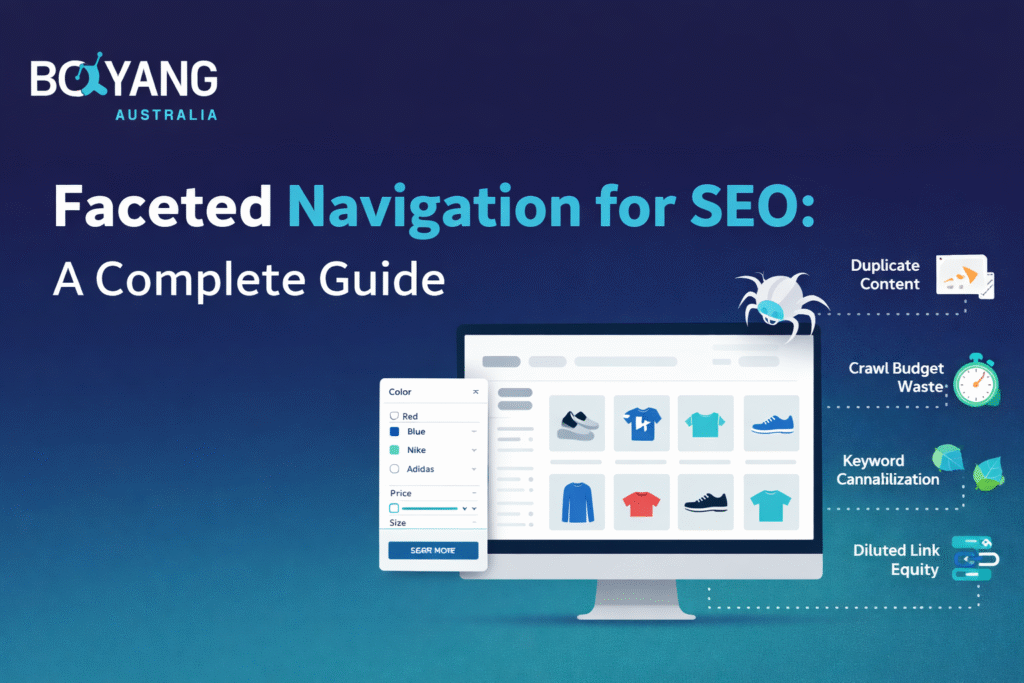
If you‘re run an eCommerce website, you’ve likely heard the term faceted navigation. It improves usability, increases product discoverability, and helps users filter large inventories quickly. But the real problem is when it has been implemented incorrectly, then faceted navigation SEO issues can quietly destroy your rankings. Duplicate pages. Wasted crawl budget. Index bloat. Diluted link equity. and so on.
Boyang Australia has audited countless eCommerce sites where filtering systems were unintentionally blocking growth. This guide explains what faceted navigation is, the SEO risks involved, and the best way to do faceted navigation without harming performance.
What Is Faceted Navigation?
Faceted navigation is also called facet navigation or guided navigation. It allows users to filter large sets of products using attributes such as:
- Colour
- Size
- Brand
- Price
- Material
- Ratings
For example, each filter combination can generate a new URL. That’s where faceted search SEO becomes complicated.
Unlike a simple filter, a faceted search engine often creates dynamic URL parameters for every selection. On large sites, this can result in thousands or even millions of URL variations. If from a UX perspective? Excellent. If fom an SEO perspective? Potentially dangerous.
Why Faceted Navigation Matters for UX
Faceted navigation for UX is a core and a simple way to help people find exactly what they want on a website with many items. Think of it like a smart group of filters that lets you pick multiple details at once, like a certain color, size, and price, to quickly narrow down thousands of choices to just a few. It keeps visitors happy and much more likely to actually buy something, because it makes product hunt, much easier and quick, so users definatly will return to a site.
Key reasons Faceted navigation for us:
- Improves user experience
- Reduces friction in product discovery
- Increases time on site
- Boosts conversion rates
- Helps users find high-intent products faster
A well-designed faceted navigation system makes browsing intuitive and enjoyable.
However, SEO faceted navigation requires technical control to prevent search engines from indexing unnecessary pages.
The 4 Biggest SEO Risks of Faceted Navigation
Without proper implementation, faceted navigation can create serious technical SEO problems.
1. Duplicate Content
Many filtered URLs show nearly identical product sets.
Example:
- /shoes?color=red
- /shoes?size=10
- /shoes?color=red&size=10
Search engines struggle to determine which version should rank. This causes duplicate content issues and ranking dilution.
2. Crawl Budget Waste
Search engines allocate limited crawl resources per site.
If bots are crawling endless filter combinations, they may ignore your important pages.This is one of the most common faceted navigation SEO issues on large eCommerce stores.
3. Keyword Cannibalisation
Multiple filtered pages may compete for the same keyword, such as:
- “blue running shoes”
- “running shoes blue”
- “shoes blue running”
Instead of one strong ranking page, you end up with several weak ones.
4. Diluted Link Equity
Internal and external links get distributed across many URL variations instead of consolidating authority on primary category pages.
Faceted Navigation Examples (Good vs Bad)
Poor Implementation:
- Every filter creates an indexable URL
- No canonical tags
- Parameter order inconsistencies
- Thin filtered pages indexed
Strong Implementation:
- Only high-value combinations indexed
- Canonical tags pointing to main categories
- Clean, structured URLs
- Low-value filters blocked from indexing
Faceted Navigation Best Practices (SEO-First Approach)
Here’s where strategy matters. These faceted navigation best practices allow you to keep strong UX while protecting SEO.
1. Control Indexing with Canonical Tags
Canonical tags tell Google which page is the “master” version.
For most filtered pages:
rel=”canonical” → main category page
This consolidates ranking signals and prevents duplicate issues.
This is one of the most essential seo faceted navigation techniques.
2. Use Noindex for Low-Value Pages
If a filtered page has little to no search demand, apply:
<meta name=”robots” content=”noindex, follow”>
This keeps it accessible to users but removes it from search results.
3. Block Irrelevant Parameters in Robots.txt
Example:
Disallow: /*?sort=
Disallow: /*?filter=
This prevents search engines from crawling unnecessary URL parameters.
However, use this carefully — blocking crawling is different from blocking indexing.
4. Use AJAX Where Appropriate
One of the best ways to manage faceted search SEO is to load filters dynamically via AJAX without changing the URL.
This preserves UX while preventing search engines from discovering thousands of parameter variations.
For many businesses, this is the best way to do faceted navigation when scale is large.
5. Only Index High-Value Filter Pages
Not all filtered pages are bad.
Example:
- /shoes/blue-running/
- /laptops/gaming-under-2000/
If data shows real search volume and intent, allow those pages to be indexed.
Block niche combinations like:
- “red trail running shoes size 9 waterproof reflective”
Strategic indexing is the key difference between bad and effective faceted navigation SEO.
6. Maintain Consistent URL Parameter Order
Ensure:
color=blue&size=m
does NOT also generate:
size=m&color=blue
This prevents duplicate variations.
7. Use Clean, Descriptive URLs
Instead of:
?color=123
Use:
/shoes/blue/
Clean URLs improve both UX and crawl efficiency.
8. Add Structured Data
Use:
- Product schema
- ItemList schema
This helps search engines understand relationships between filtered pages and main categories.
Faceted Search Best Practices for Large eCommerce Sites
For large inventories, your strategy should include:
- Crawl analysis using log files
- Index coverage monitoring
- Internal linking optimisation
- Thin content pruning
- Search demand analysis
A faceted search engine without SEO oversight often becomes a technical liability.
What Is the Best Way to Do Faceted Navigation?
There is no universal solution.
The best approach depends on:
- Inventory size
- Search demand
- Site architecture
- Platform limitations
- Crawl capacity
But the golden rule remains:
Index intentionally. Block strategically. Canonicalise consistently.
When executed correctly, faceted navigation becomes a powerful long-tail traffic driver instead of a ranking killer.
Final Thoughts: Faceted Navigation Should Support SEO, Not Sabotage It
Faceted navigation is essential for user experience on modern eCommerce sites.
But without technical safeguards, it creates:
- Duplicate content
- Crawl waste
- Cannibalisation
- Thin content
- Authority dilution
The key isn’t removing faceted navigation.
The key is controlling it.At Boyang Australia, we specialise in resolving complex technical SEO issues like poorly implemented faceted navigation systems. If your eCommerce site has thousands of indexed filter URLs, it may already be costing you rankings.
Need Help Fixing Faceted Navigation SEO Issues?
If you’re unsure whether your filtering system is helping or harming your SEO:
👉 Book a FREE Technical SEO Audit with Boyang Australia
We’ll analyse:
- Index bloat
- Crawl budget waste
- Parameter handling
- Canonical implementation
- High-value facet opportunities
Because great UX should never come at the cost of rankings.